
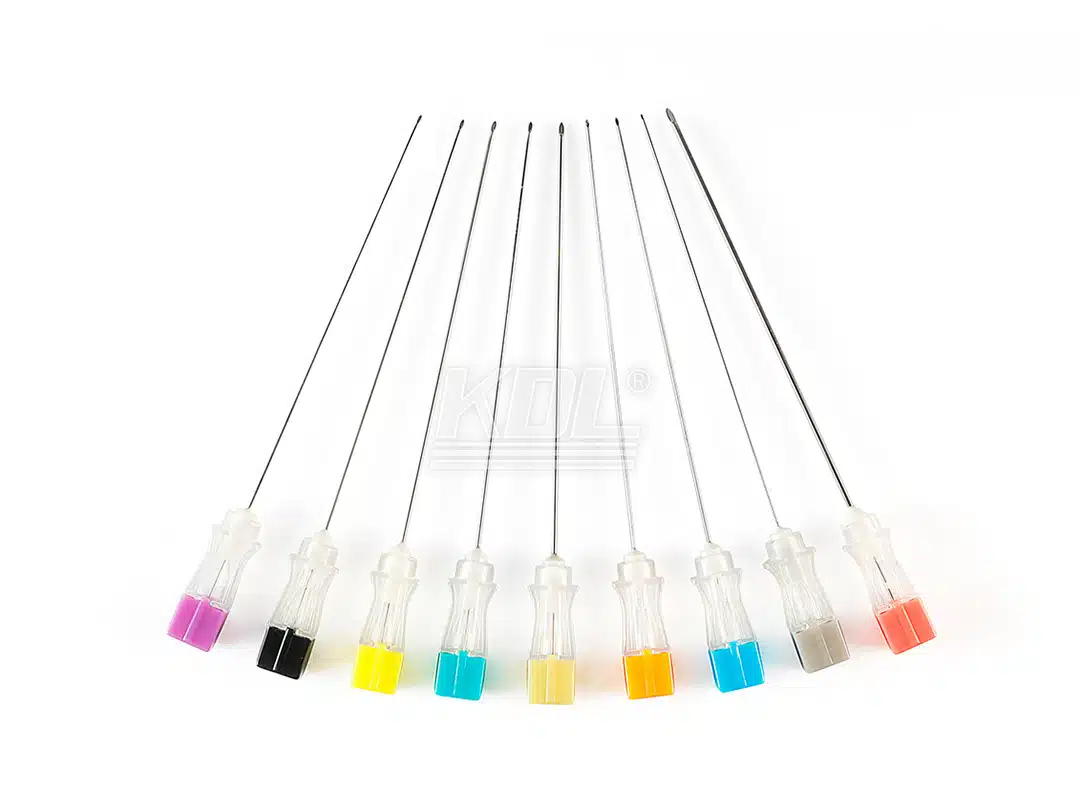
Spinal and Epidural Injection Needle
User rating:
Category: Respiratory and anesthesia
Brand:
| Needles designed to penetrate the spinal column for aspiration or injection of fluids such as anesthetic drugs, analgesics, or steroid agents, usually into the subarachnoid space in the lumbar region. These devices typically feature 18- to 27-gauge needles with lengths ranging from 50 to 150 mm and appropriate tips, including pencil-point, Whitacre, and Quincke designs, to minimize tissue injury or trauma to the tissues, nerves, and meningeal fibers. The needles are commonly connected to catheters for external fluid injection or aspiration. Some spinal needles feature wings or depth markings to facilitate accurate placement and stabilization. For pediatric use, spinal needles are typically 1 to 2.5 inches (25 to 63 mm) long. Spinal needles are used for lumbar punctures in diagnostic and therapeutic procedures, for the administration and management of regional anesthesia during lumbar procedures and childbirth, and in certain surgical procedures. |
Introduction and general information Spinal and Epidural Injection Needle
Spinal and Epidural Injection Needle
Spinal Injection Needle
Spinal needles by Dr.J are used for lumbar injection for spinal anesthesia or diagnostic procedures involving the spinal canal. Spinal introducer needles allow easy insertion of the spinal needle and provide additional support. The bevel tip of the spinal needle is made of high-quality stainless steel and features a thin-wall cannula. The smooth surface of the needle facilitates easy skin penetration. The needle hub is transparent and has a magnifying effect, allowing rapid detection of cerebrospinal fluid backflow and accurate identification of the needle tip position.
Spinal Needle Specifications
Spinal anesthesia is a suitable alternative to general anesthesia for certain surgical procedures. It allows the patient to remain awake during surgery without experiencing pain. Spinal and epidural anesthesia are types of regional anesthesia in which local anesthetic drugs are injected into the subarachnoid or epidural space using a spinal needle to numb specific areas of the patient’s body and prevent pain. The medication is injected using a needle that is typically 9 cm long. For patients with severe obesity, other needle types with a length of 12.5 cm are available. The tip of the spinal needle may have a small point or a bevel design.
Applications of Spinal Needles
Spinal needles are used to inject analgesic or anesthetic medications directly into the CSF, usually at a lumbar vertebral level. Spinal needles pass through the membranes surrounding the spinal cord to access the cerebrospinal fluid (CSF). In some cases, an introducer needle is used to stabilize needle placement and facilitate insertion through firm skin. The needle and stylet are advanced toward the dura through the intervertebral space. The stylet prevents tissue from entering the needle during insertion. An introducer needle may be used in some cases to stabilize needle placement. Injection needles are color-coded according to needle size and are available in sizes 18 to 27. Spinal anesthesia helps minimize the risk of post-dural puncture headache.
Spinal or Epidural Anesthesia Procedure
The physician who administers epidural or spinal anesthesia is called an anesthesiologist. First, the patient’s back is cleaned with a special antiseptic solution at the site where the needle will be inserted. The area may also be numbed with a local anesthetic. The patient will most likely receive fluids through an intravenous (IV) line. Medication may be administered through the IV to help the patient relax. The anesthesiologist injects the medication just outside the sac containing the fluid surrounding the spinal cord, known as the epidural space. The injection produces anesthesia or blocks sensation in a specific part of the body, resulting in reduced or no pain depending on the procedure. The medication usually begins to take effect within approximately 10 to 20 minutes. It works well for longer procedures. Epidural anesthesia is commonly used during childbirth. A small tube (catheter) is often left in place. Additional medication can be administered through the catheter to help control pain during or after the procedure.
Factors and Success Rate of Spinal Anesthesia
Successful administration of spinal anesthesia is very important for surgical procedures. Spinal anesthesia procedures have a success rate of approximately 83% to 99%. The success rate of spinal anesthesia is influenced by various factors, including the quality of the injection landmark, high-quality radiological images of the vertebrae, the anesthesiologist’s skill, patient positioning, lumbar flexion, and the distance between the skin and the subarachnoid space. Spinal anesthesia has also been shown to offer advantages over general anesthesia, as demonstrated in urological procedures such as percutaneous nephrolithotomy and transurethral prostate procedures. Documented benefits include better hemodynamic stability, reduced need for analgesics, shorter surgical duration, reduced incidence of deep vein thrombosis, and fewer adverse effects associated with general anesthesia. Patient positioning during spinal anesthesia administration also determines whether successful placement of the spinal needle into the subarachnoid space can be achieved. Improper positioning may result in repeated needle advancement, contact with bone, and traumatic contact with the spinal cord or surrounding structures. Therefore, it may increase the risk of back pain, post-dural puncture headache (PDPH), epidural hematoma, and neurological injury.
Procedures Performed Under Spinal Anesthesia
Spinal anesthesia, also known as a spinal block, is administered by injecting medication into an area called the subarachnoid space near the spinal cord. Spinal anesthesia may be used while the patient remains awake or in combination with sedation or general anesthesia, including:
- Urology: Procedures involving the prostate, bladder, or genital tract
- Orthopedics: Procedures involving the hip and leg bones
- Gynecology: Procedures involving the uterus, vagina, or ovaries
- Vascular surgery: Procedures involving blood vessels in the legs
- General surgery: Inguinal hernia and hemorrhoid procedures
- Obstetrics: Cesarean section
Benefits of Spinal Anesthesia
- Less confusion or feeling of suffocation after surgery
- Better pain relief immediately after surgery
- Reduced need for strong pain medications
- Less nausea and vomiting
- Less impact on the patient’s heart and lungs
- Lower risk of chest infection
Less Common Complications of Spinal Anesthesia
- Nerve injury
- Hearing loss or changes in hearing
- Cardiovascular collapse
- Allergic reaction
- Infection around the spine
- Paralysis or death
Potential Risks of Spinal Anesthesia
- Spinal injury
- Pain during injection
- Low blood pressure
- Headache
- Itching
- Difficulty urinating
- Back pain
Spinal Needle Color Coding and Sizes
- Pink – Size 18
- Cream – Size 19
- Yellow – Size 20
- Green – Size 21
- Black – Size 22
- Blue – Size 23
- Brown – Size 24
- Orange – Size 25
- Purple – Size 26
- Gray – Size 27
Features of Spinal Needles
- Needle manufactured from high-quality stainless steel
- Suitable for injection of analgesic or anesthetic medications
- Needle length of 90 mm for all sizes
- Color-coded according to diameter for clear identification
- Fully transparent hub for visualization of cerebrospinal fluid flow
- Needle core with a connector pin at the needle edge
- Sterilized with EO gas; non-toxic, non-pyrogenic, and single-use
- Larger internal diameter and high flow rate
- Beveled needle tip for maximum clarity and patient comfort
- Transparent medical-grade PP hub for clear visualization of CSF return
Reviews
There are no reviews yet.