
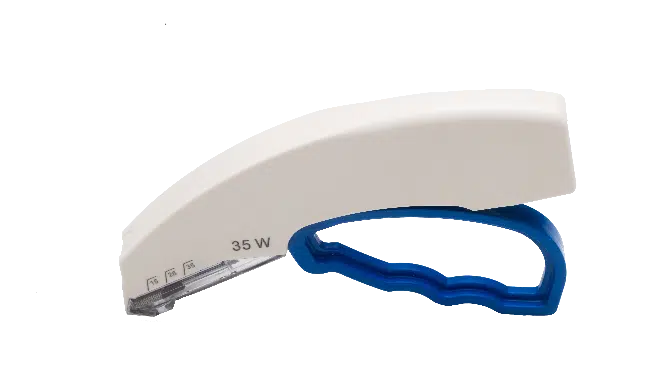
Introduction and general information Dermal stapler
What Is a Skin Stapler?
A skin stapler, or surgical staples, are medical devices that may be used instead of sutures. Skin staplers can close large wounds or incisions more quickly and may cause less pain for patients than sutures. They are often used in minimally invasive surgeries.
They can also be used to close wounds in areas where the skin is tightly attached to the bone, during limb amputation procedures, or to connect or reattach sections of internal organs.
Skin staplers or surgical staples are usually made of plastic and are loaded with a disposable cartridge containing surgical staples. Staples are available in reusable and disposable models. They resemble construction or industrial staplers and are designed to place and close multiple staples simultaneously.
These devices may be used internally to seal tissue during surgery. They are useful in minimally invasive procedures because they require only a narrow opening and can quickly cut and seal tissues and blood vessels. Skin staples are used externally to close skin under high tension, such as on the scalp or trunk of the body.

Skin staplers have several advantages over sutures.
- They increase the speed of wound closure.
- They reduce the duration of surgery and anesthesia.
When Are Surgical Skin Staplers Used?
Skin staplers or surgical staples are often used to close abdominal and uterine incisions during cesarean delivery, as staples may allow women to recover more quickly and reduce scar tissue. Surgeons may also rely on surgical staples when removing part of an organ or cutting internal organs and tissues.
They are also used to connect or reconnect internal organs within an organ system. These devices are often used for surgeries involving the digestive system, including the esophagus, stomach, and intestines, where part of these tube-like structures is removed and the remaining sections need to be reconnected.
Removal of Skin Staples
Skin staples usually remain in place for one to two weeks, depending on the type of surgery and the location of the staples. In some cases, internal staples may not need to be removed. They may either be absorbed or become permanent supports that keep internal tissues together.
Removing surgical staples from the skin is usually not painful. However, they should only be removed by a healthcare professional. Never attempt to remove surgical staples yourself.
Removal requires a sterile environment and a specialized surgical staple remover or extractor.
When to Contact a Doctor
- Bleeding that is enough to soak through the bandage
- Foul-smelling brown, green, or yellow pus around the incision site
- Discoloration of the skin around the incision
- Difficulty moving the area around the incision
- Dryness, darkening of the skin, or other changes around the site
- Fever of 100°F or higher lasting for more than 4 hours
- New or severe pain
- Cold, pale, or tingling skin near the incision site
- Swelling or redness around the incision site
What Are Skin Staplers Made Of?
Common materials used for skin staplers include stainless steel and titanium. Both are strong metals that generally cause few problems for patients during surgical procedures.
However, plastic staples are often used for people with metal sensitivities or to reduce scar tissue.
Staples made of plastic or metal, like many sutures, are not absorbed by the body, so additional care is required to prevent infection.
Reviews
There are no reviews yet.