
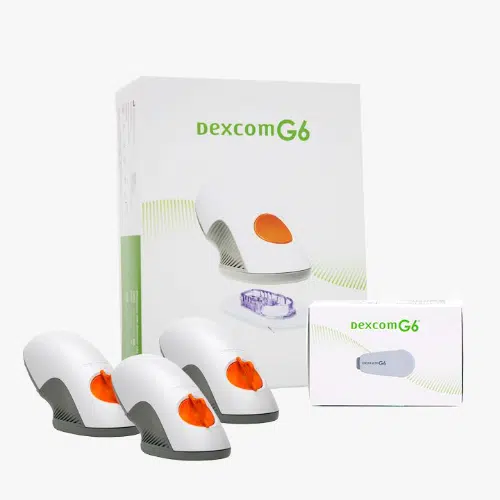
Continuous Glucose Monitor (Blood Glucose Monitoring Device)
User rating:
Category: Blood sugar test / Pharmacy
Brand:
Dexcom G6 is a non-invasive device designed to measure and record glucose levels in people with diabetes.
- Suitable for individuals aged 2 years and older.
- Features high and low glucose alerts.
- The sensor is replaced every 10 days and may be extended depending on usage conditions.
- Can transmit glucose data from the person’s mobile phone to their caregivers.
Dexcom G6 Components
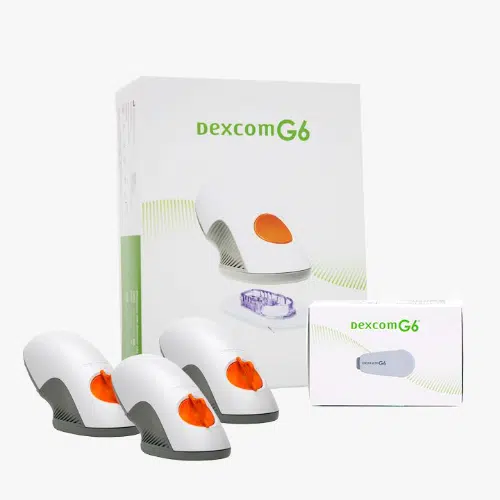
The use of this device requires a sensor and a transmitter.
Each transmitter typically lasts approximately 90–110 days.
Sensor Adhesive Protection
A protective sensor adhesive patch can be used to secure the sensor in place.
If you are sensitive to the sensor adhesive, special under-sensor adhesive patches can be used.
Introduction and general information Continuous Glucose Monitor (Blood Glucose Monitoring Device)
Surely, you are familiar with the BGM device, and if you have diabetes, you may have experience using this device. As you know, this device is used to measure blood glucose levels. But do you know what a CGM device is? How much do you know about it? In this article, we will introduce you to the Continuous Glucose Monitoring System, or CGM device.
Introduction to the CGM Device
A CGM device, or Continuous Glucose Monitoring System, is a device that continuously tracks blood glucose levels throughout the day and night. It can alert the user when blood glucose levels are too low or too high. The device measures glucose levels at regular intervals, typically every 5 minutes, and translates the collected information into easy-to-read data and insights for the user. It can also measure the direction and rate of change in glucose levels.
Why Use a CGM Device?
You may now be wondering why a CGM device is necessary. With a Continuous Glucose Monitoring System, you can view your glucose readings directly on your smart device or receiver without having to obtain a blood sample from your fingertip. You can even see whether your blood glucose level is trending upward, downward, or remaining stable. This allows you to make better decisions about the foods you eat, the physical activities you engage in, and the amount of insulin you use. In fact, using a CGM device reduces the need for guesswork and makes diabetes management much easier.
How the Continuous Glucose Monitoring System Works
As mentioned above, a CGM device, or Continuous Glucose Monitoring System, tracks a person’s glucose levels throughout the day and night and, when necessary, alerts the user when blood glucose levels are too high or too low. But how does this system work? In this section, we explain how the device operates.
In general, using this device is very easy. CGM users need to insert a thin sensor filament under the skin using an automatic applicator. The CGM device is secured in place with an adhesive patch so that it can continuously measure glucose levels in the interstitial fluid 24/7.
A small, reusable transmitter is then attached to the sensor filament and automatically sends real-time readings to a smart device or receiver, allowing the user to view glucose readings without having to obtain a blood sample from the fingertip.
The smart device displays current glucose levels as well as historical glucose trends. It also features customizable alarms that can alert the user when blood glucose levels are too high or too low.
Comparison of CGM and BGM Devices
Studies conducted on blood glucose monitoring devices have shown that the use of some CGM systems may help reduce A1C levels and the risk of hypoglycemia in people with diabetes who use insulin injections as well as those who use insulin pumps. However, an important question is: What is the difference between a CGM device and a BGM device? This section provides a brief comparison of these two systems.
- A BGM device measures blood glucose levels at a single point in time, whereas Continuous Glucose Monitoring systems (CGM) continuously monitor glucose levels throughout the day and night and can alert the user when glucose levels are too high or too low.
- BGM devices require a blood sample from the fingertip each time a glucose reading is taken. In contrast, CGM devices continuously monitor glucose levels 24/7 without requiring repeated finger-stick blood samples.
Product specifications
Selected images
Reviews
There are no reviews yet.